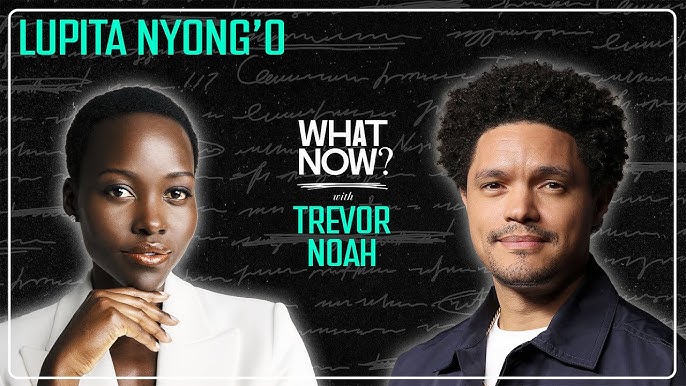
Lupita Nyong’o, the Academy Award-winning actress known for her iconic roles in 12 Years a Slave and Black Panther, recently sat down with Trevor Noah for an insightful conversation on The Daily Show. Their discussion touched on a range of topics, from Lupita’s thoughts on representation in Hollywood to her new ventures and how she’s navigating the evolving landscape of entertainment and her latest project—a new podcast exploring important cultural conversations.
Empowerment Through Representation
One of the central themes of Lupita’s conversation with Trevor was the power of representation, especially for marginalized communities. Reflecting on her journey in Hollywood, Lupita discussed the importance of seeing diverse, authentic stories on screen. “For me, being in this industry has always been about telling stories that reflect the complexities of who we are as people,” she explained. “The more we see diverse narratives, the more we see humanity in its fullness.”
Lupita recalled the moment she was cast in 12 Years a Slave, a role that not only earned her widespread recognition but also allowed her to contribute to a larger cultural dialogue about race, history, and identity. “When I first got that role, I didn’t fully understand how impactful it would be,” she said. “But it was a chance to tell a story that was about a woman who had endured so much, and I realized the importance of putting that truth out into the world.”
Black Panther and the Legacy of African Representation
Lupita also touched on the transformative impact of Black Panther, a film that redefined how African stories are told in mainstream media. “Black Panther wasn’t just a movie,” she told Trevor. “It was a movement. We were able to change the way the world saw Africa, and that was such an honor to be a part of.” The film’s success was not just about superhero spectacle, she said, but about the celebration of African culture, innovation, and beauty on a global stage.
“For me, that film was a chance to embody a character that I could connect with,” Lupita continued. “It was a love letter to Africa, and we were able to show that African excellence is something the world needs to recognize and celebrate.”
Personal Growth and Embracing Identity
The actress also spoke about her personal journey toward self-acceptance, particularly as it relates to her identity as a Black woman in the entertainment industry. Growing up in Kenya, Lupita recalled how Western beauty standards often made her feel like she did not fit in.
“I grew up in a world where beauty was often defined by a very narrow standard,” she said. “But it took time and a lot of unlearning to realize that my own beauty is not something that has to conform to anyone’s idea of it.”
Her career in Hollywood, she said, has been a vital part of that transformation. “I’ve found so much power in my identity through the roles I’ve chosen,” Lupita shared. “In many ways, Hollywood has allowed me to redefine what beauty means and to embrace who I am, flaws and all.”
A New Podcast: Continuing the Conversation
In the interview, Lupita also introduced her latest venture—a podcast titled The Art of Storytelling, which delves into the importance of representation and explores how storytelling can shape cultural narratives. “The podcast is really about giving people a space to share their stories, to hear voices that aren’t often heard,” she explained. The show, which features conversations with artists, activists, and creators from various backgrounds, is Lupita’s way of continuing the work she began with her roles on screen, expanding the conversation around representation, identity, and the power of storytelling. “The podcast is about exploring how stories can transform us, how they can change the world,” she said. “It’s about finding new ways to connect and to elevate voices that need to be heard.”
Chadwick Boseman’s Legacy
The conversation also turned to the late Chadwick Boseman, who played King T’Challa in Black Panther. Lupita spoke movingly about his impact, both as an actor and as a person. “Chadwick was not just an incredible talent, he was a force of nature,” she shared. “He had such a commitment to his work and to his people. He was a leader in every sense of the word.” Reflecting on their work together in Black Panther, she added, “Being in that space with him was truly special. Creating something so meaningful together was a remarkable experience. And his legacy will live on through that film.”
Changing the Narrative
Lupita gave an inspiring message about the role of artists in shaping the future.
“We are in a moment of change in the world,” she said. “We are seeing stories that have long been marginalized finally take center stage, and that’s because people are demanding to hear them. It’s an exciting time, but we still have so much work to do.”
Discover more from Global-360 Africa
Subscribe to get the latest posts sent to your email.